
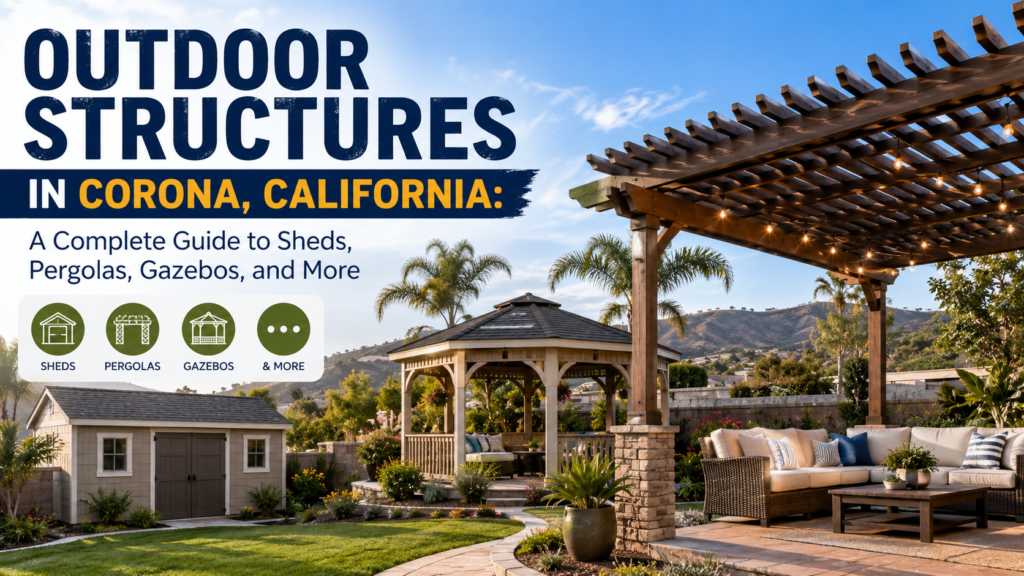
Corona, California sits in the heart of the Inland Empire, a city known for its sunny weather, spacious residential lots, and a strong culture of outdoor living. With approximately 280 days of sunshine per year and mild winters, Corona homeowners have every reason to make the most of their outdoor spaces. Outdoor structures from practical storage sheds to elegant pergolas and covered pavilions are among the most impactful additions a property owner can make, extending livable space, improving functionality, and adding measurable value to a home. Understanding the different types of Outdoor Structures Corona, what each is best suited for, and how the Corona climate shapes those choices helps homeowners make confident decisions about their backyard investments.
Why Outdoor Structures Make Sense in Corona’s Climate
The Inland Empire’s climate is one of the most outdoor-living-friendly in the country. Summers in Corona are warm to hot, with temperatures regularly in the 90s and occasionally topping 100°F. Winters are mild with very limited rainfall. This combination means homeowners can realistically use covered outdoor structures for nine to eleven months of the year far longer than in most parts of the United States. A well-placed shade structure, for instance, can transform an otherwise unusable sunny corner of a yard into a comfortable retreat from spring through fall. Storage sheds protect lawn equipment, tools, and seasonal items from the dry heat that can degrade materials left exposed. The climate in Corona essentially rewards investment in outdoor structures by extending their usability over an exceptional proportion of the year.
Storage Sheds: Practical Space Solutions
The storage shed is the most functional category of outdoor structure, and for many Corona homeowners it is the first addition that makes a tangible difference in how the property is used day to day. Yards in the Inland Empire tend to house more outdoor equipment than in colder regions lawnmowers, irrigation supplies, pool chemicals, patio furniture cushions, gardening tools, bicycles and a quality shed provides organized, weather-protected storage for all of it.
Sheds come in a wide range of sizes, from small 6×8 garden sheds suited to tool storage, to large 12×20 or 16×24 structures capable of accommodating a full workshop, riding mower, or extra vehicle. Material choices include:
- Wood sheds: Offer the most natural appearance and can be painted or stained to match the home. They require periodic maintenance repainting or re-staining and must be properly ventilated to prevent heat buildup in Corona’s warm summers.
- Vinyl or resin sheds: Low-maintenance and resistant to rot and insects. They do not require painting and hold up well in direct sun, making them a practical choice for Corona’s climate.
- Metal sheds: Strong and cost-effective. In Corona’s hot summers, metal sheds can become very warm inside, which may matter if sensitive items are stored. Proper ventilation helps manage interior temperature.
In Corona and surrounding Riverside County, permits may be required for sheds over a certain footprint typically 120 square feet or larger triggers a building permit under California Building Code. Homeowners should confirm with the City of Corona Building Department before constructing a shed of significant size.
Pergolas: The Aesthetic Statement
The pergola is arguably the most versatile and aesthetically powerful outdoor structure a homeowner can add. Defined by its open-lattice roof of horizontal beams over vertical posts, a pergola provides partial shade while maintaining airflow and visual openness. It does not provide complete rain protection but in Corona, where rainfall is modest and concentrated in a few winter months, this is rarely a significant limitation.
Pergolas are most commonly placed over a patio or deck adjacent to the home, creating a defined outdoor room that bridges the interior living space and the yard. They can also be positioned over an outdoor kitchen, a hot tub, a garden seating area, or along a walkway. Climbing vines wisteria, jasmine, bougainvillea are frequently trained up pergola posts and across the overhead beams, adding botanical beauty, additional shade, and fragrance.
Material options for pergolas include natural wood (cedar and redwood are popular for their resistance to rot and their attractive grain), pressure-treated pine, aluminum, and vinyl. Aluminum pergolas are growing in popularity in the Inland Empire because they resist the warping and cracking that summer heat can cause in wood, require no painting or staining, and maintain their appearance for decades with minimal care.
Gazebos: The Classic Backyard Centerpiece
The gazebo offers something a pergola cannot: complete overhead protection. A gazebo features a solid roof typically shingled, metal, or polycarbonate supported by posts, with open or screened sides. The traditional gazebo shape is octagonal or hexagonal, giving it a distinctive classical appearance that makes it a true backyard centerpiece. Rectangular and square gazebos are also available and integrate more easily with existing patio layouts.
In Corona, a gazebo extends the usable season of an outdoor sitting area by providing shade from intense afternoon sun and shelter during the occasional rain showers of winter and spring. Many gazebos can be enhanced with add-ons: ceiling fans for summer ventilation, string lights for evening ambiance, outdoor-rated curtains for privacy, and even screen panels to keep the area comfortable during warmer evenings when insects are active.
Gazebos function particularly well as outdoor dining spaces, garden focal points, and casual entertaining areas. Because they are freestanding and typically positioned in the middle or corner of a yard, they give the landscape a strong visual anchor that improves the overall appearance and perceived size of the outdoor space.
Pavilions: The Entertainer’s Choice
The pavilion shares the gazebo’s solid roof but differs in shape pavilions are typically rectangular or square rather than octagonal, have fully open sides by default, and are designed to accommodate larger gatherings. Where a gazebo is a retreat for one to four people, a pavilion comfortably hosts a full outdoor party.
Pavilions in Corona are frequently paired with outdoor kitchens, barbecue stations, fire pits, and sound systems to create fully equipped outdoor entertainment spaces. They are large enough to shelter dining tables, outdoor sofas, and even outdoor televisions, making them a natural hub for the social outdoor lifestyle that the Inland Empire’s climate supports so well.
Roof styles for pavilions vary widely: gable roofs, hip roofs, shed roofs, and multi-pitch designs are all available. The roof style significantly affects the pavilion’s visual character a gable roof has a traditional, symmetrical look, while a shed-style mono-pitch roof gives a more contemporary profile. Pavilions are built from wood, steel, aluminum, or vinyl depending on the desired appearance, maintenance commitment, and budget.
Carports and Shade Structures
In a city like Corona where vehicle ownership is high and the intense summer sun can damage car interiors and paint, carports and shade structures serve a very practical purpose. A carport provides covered parking without the full enclosure of a garage, protecting vehicles from sun, dust, and light rain while maintaining an open, airy feel.
Shade structures range from simple steel or aluminum posts with a polycarbonate or shade-cloth roof to more elaborate structures that integrate with the home’s architecture. In Corona’s HOA communities which cover a significant portion of the city’s residential neighborhoods any addition including a carport or shade structure must typically be reviewed and approved by the homeowners association before installation. Checking HOA architectural guidelines is an essential first step for homeowners in these communities.
Outdoor Kitchens and Combination Structures
Corona homeowners who entertain frequently often combine multiple outdoor structure elements a covered pavilion or pergola overhead, built-in barbecue and countertop stations, a bar area, and comfortable seating into a cohesive outdoor kitchen and entertainment zone. These combination structures are among the highest-return outdoor improvements a homeowner can make in terms of lifestyle enhancement and property value.
The key to a successful outdoor kitchen in Corona’s climate is choosing materials that withstand prolonged heat and UV exposure: stainless steel appliances, stone or concrete countertops, weatherproof cabinetry, and overhead shade that reduces direct sun exposure on both the cook and the cooking equipment.
Permits and HOA Considerations in Corona
Before any outdoor structure is built in Corona, two sets of requirements must be checked. First, the City of Corona’s building permit requirements: structures above certain sizes, structures with electrical or plumbing, and structures that cross property setbacks typically require building permits. Second, HOA architectural review if the property is in an HOA community which applies to a substantial proportion of Corona’s neighborhoods. Working with an experienced local builder who is familiar with both City of Corona permit requirements and HOA processes ensures a smooth project from planning through completion.
Conclusion
Outdoor structures in Corona represent a natural extension of the Inland Empire lifestyle turning good weather into usable living space, organizing properties more effectively, and creating environments that bring families and friends together outdoors. Whether the goal is practical storage, elegant shade, entertaining capacity, or a combination of all three, there is an outdoor structure solution well-suited to every Corona property. Understanding the options, the material considerations appropriate to the local climate, and the permit and HOA requirements specific to Corona prepares homeowners to make decisions they will enjoy for years.